

I’ve been using Claude Code for months, and it’s convinced me that profound change is coming to my industry. I’m not sure it will all be good. What I do know is that tools like Claude Code (CC) make coding more productive and more fun. I got into this business because I loved making things, especially things my friends want to use. These tools make that easier than ever, and I’m having more fun with code than I’ve had in years.
I’m not unique. Claude takes advantage of my strengths, which I think will apply to many other experienced software engineers. I think of these as the three hats I wear as a developer when developing projects:
- Architect: Understanding what makes a good development plan and solution for the problem at hand
- Editor: A willingness to iterate to a great final draft
- The Opinionated: Understanding what matters to make a great product or solution (and what doesn’t matter)
Architects #
Every experienced CC user will tell you, giving Claude a great plan makes a huge difference. With a good plan and good guidance, CC can get you amazing results. I expect you’ll see a lot of stories like this one in 2026:
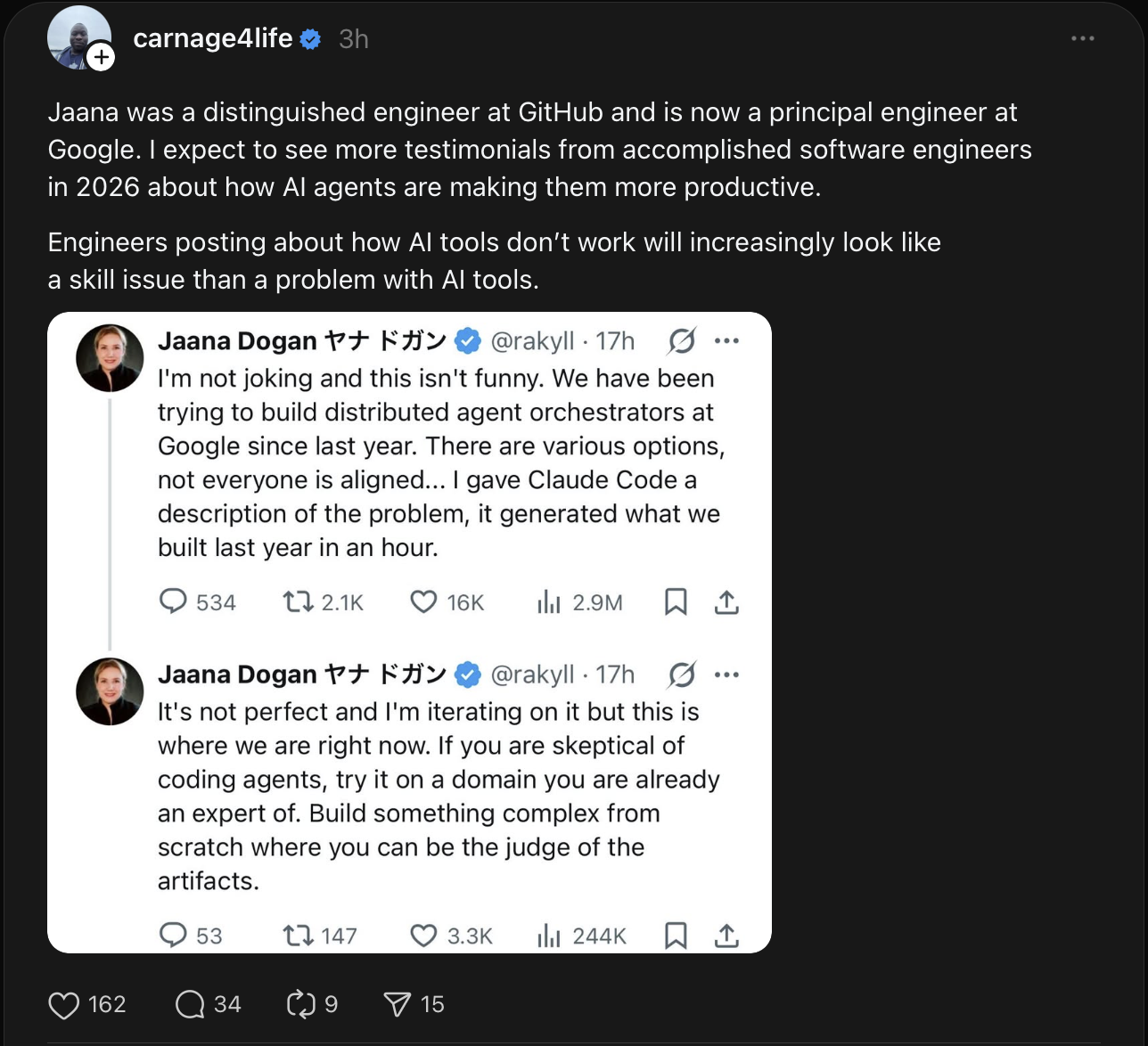
This matches my experience as well. For a project like LLStudyGuide.com, I spent time creating good PRDs and design documents. Claude and I cranked out the initial version of that app in ~8 hours. CC got the initial parsers and data ingest done in an hour or less.
The key skill here is being able to clearly articulate a product problem, the technical constraints that matter, and to provide all the details that matter to the solution. Even with my experience, I struggle with pointless (to me) technology choices when starting from scratch (vite? turbopack? webpack? who cares!) because I want to “get it right” at the start. Claude takes all that friction away, letting me focus on the architectural or product choices that actually matter.
Editors #
These tools still make a lot of mistakes. You may also find out halfway through a feature that an earlier choice wasn’t the right one, and you’ll need to refactor. A willingness to embrace this iteration - knowing that CC will make fixes & refactors painless enough - is also a mindset shift. The process your English teacher probably tried to instill - outline, draft, read, edit/revise, repeat - is a key part of an agentic workflow.
Experience helps here - I spend more of my time reviewing code than writing it now, aided by AI, of course.1 Reading code efficiently is the key skill, along with mastering supporting tools that can help you keep up. I also care a lot more about the thoroughness of my test suite than I ever have.
The remaining question for me is how we train juniors - I learned by making mistakes writing lower-level code. We’re going to need to rethink how juniors gain the experience to become capable seniors in this new world.
The Opinionated #
You’re going to be able to crank out code faster than ever. What code matters, and what problems you need to work on will be the next differentiator. On most of my projects now, I’m spending more time sweating the product details vs worrying about low-value decisions. It helps that I have strong opinions on what makes a great product, or how I want a tool I’m building to work.
Differentiating products in a world where anyone can code will come down to how things work for a user, not the technical implementation itself. People that sweat the details (and sweat the right ones) will be able to move faster and ship better products. It’s that simple.
With LLStudyGuide, I spent the vast majority of that 8 hours tweaking the content pipeline and content generation prompts so I got the content I really wanted to listen to. Before these tools, I would’ve spent that initial weekend just cranking out the initial API code to stitch together the MVP content pipeline.
Beyond the individual engineer #
If you step back for a second, these attributes - problem domain expertise, a willingness to iterate and refine, and sweating the (right) details - have always separated great operators from everyone else.
I’m currently reading Vibe Coding by Gene Kim & Steve Yegge. As we’re working to roll out these tools to 100% of our engineering team at the day job, this passage has stuck with me:
Our leading hypothesis, which we’re hoping to validate in 2025 in a joint research project with DORA, is that AI amplifies whatever process hygiene you already have. If you don’t have fast feedback loops, expect more trouble.
Missing tests? Now you’re missing those tests at 1,000+ lines of code per day per developer. A ten-developer team might crank out 60,000 lines a week. Have bad architectures that don’t enable independence of action? Either you’re still stuck, or each change is blowing up services faster than ever.
That’s the underlying theme for 2026 - whether it’s at the individual level, or the enterprise, AI coding tools will emphasize the skills you already have. The good thing about skills is that you can learn/teach them. When you nail those three skill buckets, these things are a huge unlock.
Now, let’s get to the links.
Reads #
- Introducing Beads: A coding agent memory system: Planning is so important that folks are building their own systems to manage plans. I’ve been using the Linear MCP as my way of creating a planning buffer for CC, but this tool has some nice features. Will try it on the next project.
- The sold-out Nex Playground made my kids laugh and cry: I read a few reviews of this on Christmas Eve, and was able to snag one from Target that day (seemingly the last place in my entire area that had one). The Wall Street Journal had a great story about the startup behind the Nex (or read on Apple News+).
- carnage4life on Threads: This is the link to the Threads post I shared above. The replies are interesting, if you want to get a sense of the sentiment around this post. Keep in mind that the most gung-ho AI audience is on Twitter. Make of that what you will…
- Someone made a ton of money betting on Maduro’s capture: Setting aside my other thoughts on today’s news, this is going to be a huge problem for these prediction market sites. Working in regulated gaming, I know how much of a burden those regulations can be, but I also see what transparency it forces on the industry. Feels like some of that may need to be brought to the prediction market companies.
Code & Tools #
- Experiment.Red: My first one-shot project, a simple script to add DJ sets on YouTube to my Apple Music library. It’s a simple wrapper around yt-dlp that grabs the audio from a YouTube video, chops it up, and adds metadata, artwork, and sets it up for continuous (no gap) playback.
- LL Study Guide: Another one of my CC-driven projects, this is a podcast that reviews the questions from a daily trivia group I’m in. I wrote up more about this project here: Experimenting with an AI powered content generation workflow.
- ESPHome LilyGo T5 4.7" Components: I have a small e-ink dashboard I built about 2 years ago. Over the last few months, the screen was starting to get garbled or the text would appear faded or partially missing. I genuinely was worried the screen was failing. I decided to take an evening and upgrade ESPHome on the device to see if it would help fix it. Turns out the component that drives the screen was no longer maintained or compatible with the newest ESPHome. So, pulled out Claude Code, told it to help me refactor the components for the latest ESPHome. Two hours later, I had a fixed component AND Claude refactored my app code to improve the drawing performance. The screen looks as good as new.
- N8N.io: I’ve started moving away from IFTTT and running those little triggers and workflows on a self-hosted instance of N8N. So far, it’s been working well. I’m still getting up to speed, but it seems promising for even more use cases than IFTTT. The only thing that really sucks is that they REALLY want you to upgrade to a commercial plan, so the UI is littered with upsell CTAs. The self-hosted option is prohibitively priced - it’s either it’s free or expensive - Business is $800/mo. So, the community/free edition it is for me.
Watch #
- Making 20 Upgrades for my Desk Setup - Dream Setups #2: This video inspired me to get back into 3D printing this break. I upgraded to a BambuLab P2S, inspired by this video. The printer is amazing. My desk still doesn’t look this clean, though. 🙂
- My Claude Code Workflow for 2026: From Ray Amjad, whose channel I find very useful, this is an overview of his workflow.
Listens #
- Sharp Tech: Google Starts Dancing, The Winners and Losers of Gemini Week, OpenAI Has an Advertising Problem: This is a little old, but a really good overview of Google’s advantages in the AI battle. (subscriber only podcast, but the link has a preview)
-
I prefer using Copilot to review Claude’s code, but I’ve had good success with the Claude Bot, too. ↩︎